A sales academy that runs itself
An online sales academy set up every new student by hand. We learned how it worked, drew it, and automated it end to end. Today every sale ends with a student ready to start, with nobody touching a thing.
- Business
- Online sales academy
- The problem
- After every payment, the owner handled the welcome, the access, the contract and the instalments by hand.

The business and its problem
The academy trains salespeople: the ones who book the calls and the ones who close the sales. Then it connects them with companies looking for people to sell. It sells its courses online, and every sale opens new work: the welcome, access to the course platform, the contract and the instalments.
The owner did all of it by hand, after every payment. The more sales, the more hours went into tasks that repeat the same way every time, and the easier it was to forget something: an email that never went out, a contract nobody chased, an instalment that slipped.
What we surveyed
- Welcome email
- By hand, after every payment
- Platform access
- By hand, one student at a time
- Contract
- By hand, chased personally
- Pending instalments
- In a spreadsheet
- Ads report
- By hand
How we analysed it
Before building anything, I sat down to understand how they worked. We wrote down every task repeated after a sale, how it was done and where it got stuck.
With that I drew the process end to end and we wrote a glossary: words like "onboarding" or "operator" mean one thing for everyone, so nobody gets confused when asking for a change.
Every important decision was written down with its reason. If someone asks in a year why something works the way it does, the answer is written.
The process, end to end
Glossary
- Onboarding
- The moment a student is ready to start: with access, contract and welcome.
- Operator
- The team member who gets the alerts and approves anything sensitive.
- Instalment
- Each of the parts the course is paid in.
- Alert
- A message to the operator when something needs a person.
A decision in writing
Two WhatsApp channels, one per audience.
Alerts for the team and messages for students never mix.
Status: accepted
What we built
The system takes every sale and does, in order, everything the owner used to do. Each step triggers the next. If one fails, it tries again, and if it keeps failing it alerts a person.
Below is the plan of that route, what a day of the system looks like, and the real workflow, inside.
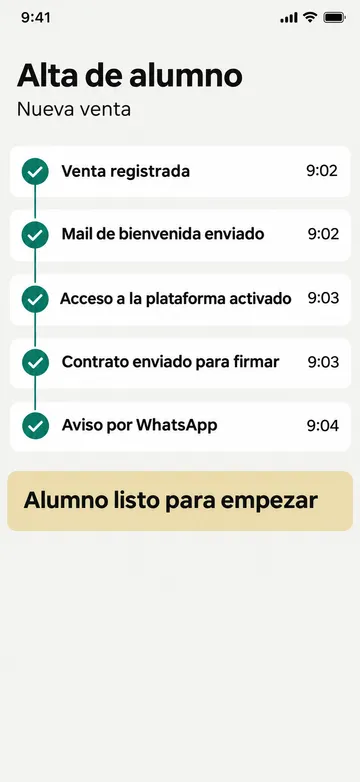
What happens after every sale
- Sale recorded
- Welcome email
- Platform access
- Contract to sign
- WhatsApp alert
If something fails: retry and alert the operator
A sample day of the automation system, with made-up data: a sale is recorded, the welcome email goes out, platform access is turned on, the contract is sent and signed, and instalment reminders go out without anyone sending them by hand.
Each step triggers the next. Nobody has to remember anything.
See the real workflow, inside
And what runs around it
The sale was the first step. Other repeated tasks followed: instalments, reports, following up each student and finding work opportunities for them.
The owner doesn't have to open any system: whatever needs their go-ahead reaches them on WhatsApp, and they approve it from there.
Plan of what runs on its own
Instalments
Every day it checks the instalments and sends the reminders to whoever is due.
Diagnostic
Each student answers a diagnostic: the system places them on four axes, gives them a profile and builds a 15-day plan.
Opportunities
It gathers the job offers posted in the community, sorts their details and sends a daily summary.
Ads report
Every week the campaign summary arrives on its own.
Operator's assistant
The operator asks it for things on WhatsApp; anything sensitive waits for their approval.
The contract, day by day
- Day 0The contract goes out to sign.
- Day 2First reminder to the student.
- Day 5Second reminder.
- Day 7Alert to the operator.
How it is checked and kept running
A system that works on its own has to speak up when something goes wrong. A health check goes over the server point by point: every service running, the automations loaded, backups in place and WhatsApp connected.
The system has its own automatic tests, every change is reviewed before it goes in, and a check makes sure no password is written where it shouldn't be. There are server backups, and restoring one is automated too.
Some automations stay switched off until their check passes: better that something doesn't run than that it runs wrong.
Server health check
- Every service is running
- The automations are loaded
- Backups exist
- WhatsApp is connected
Every change
- Proposed
- Reviewed
- Merged and on record
Where it stands
There are no usage metrics to show, and I won't make them up. What I can show is what runs on its own today, every day, without the owner stepping in.
To give a sense of size: there are 12 automatic workflows, each a chain of 3 to 40 steps.
There are 24 decisions written down with their reasons, like the one about the two channels.
And the health check goes over 27 points on the server.
What runs on its own today
- Every sale sends the welcome email, the platform access and the contract to sign on its own.
- If the student doesn't sign, the system reminds them, and if they still don't, it alerts the operator.
- Instalment reminders go out every day, with nobody sending them.
- The ads report arrives on its own every week.
- If something fails, the system retries and alerts a person on WhatsApp.
Does your business have something similar?
Tell me how you work today. I'll reply with questions to understand it and, if it's a fit, a written proposal.
Email me